
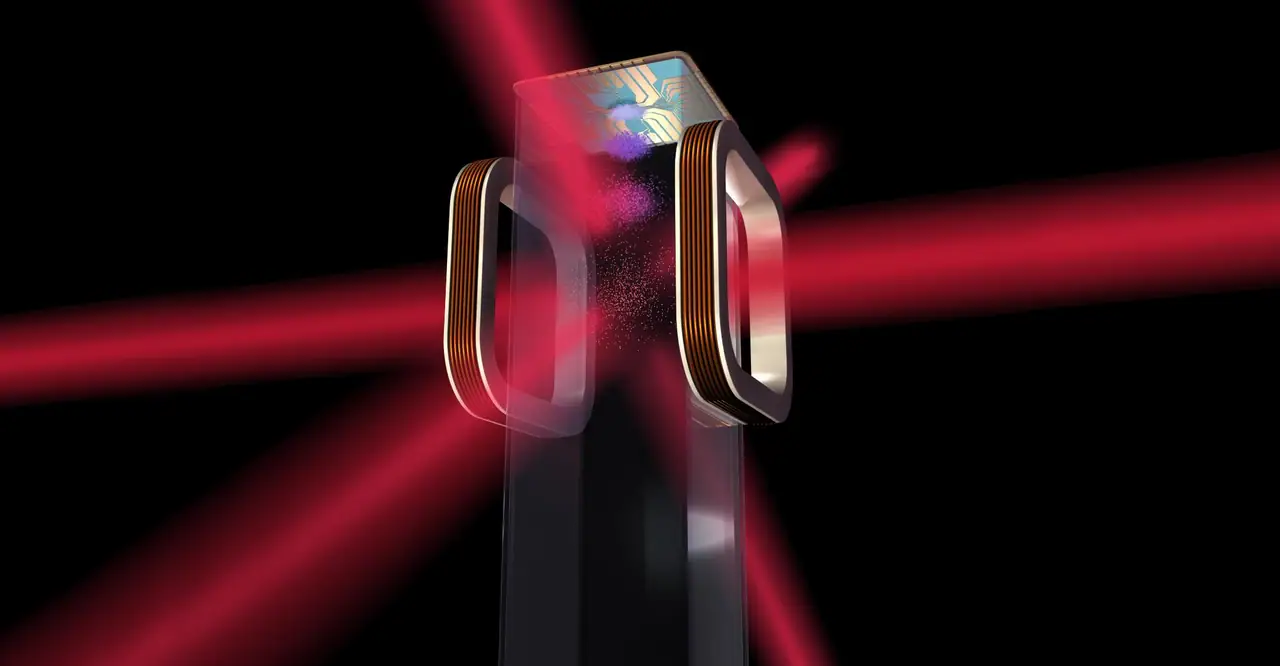
High-Fidelity Universal Quantum Gates in a Cryogenic Atom Array
Junlan Jin, Donghyuk Seo, Yue Shi, Yukai Lu, Jeff D. Thompson, Waseem S. Bakr
Abstract
Neutral atoms in optical tweezer arrays have emerged as a leading platform for quantum information processing. The fidelity of entangling gates mediated by Rydberg interactions has improved rapidly and is increasingly constrained by blackbody-radiation-induced transitions, which shorten Rydberg lifetimes and create contaminant states that can cause correlated errors. Cryogenic environments can suppress these transition rates by more than an order of magnitude. However, realizing a universal gate set in such an environment has remained an outstanding challenge. Here, we demonstrate a universal quantum gate set in a cryogenic $^{133}$Cs atom array, with a single-qubit gate fidelity of 99.970(2)% and a raw two-qubit entangling-gate fidelity of 99.76(8)%, within the range of leading room-temperature implementations. The entangling gate uses direct single-photon coupling between the electronic ground state and a Rydberg $P$ state, avoiding scattering and light shifts associated with two-photon coupling. The gate operates at a modest Rabi frequency of $2π\times4.3$ MHz. The measured fidelity agrees with our error model dominated by atomic motion, indicating a straightforward route to higher fidelity through improved cooling, while the fundamental error contribution from Rydberg decay is below $3\times10^{-4}$. These results establish a path to entangling-gate fidelities substantially beyond the current state of the art through cryogenic suppression of Rydberg decay, reducing the overhead for fault-tolerant computation.
Abstract: arXiv descriptive metadata (CC0). Thank you to arXiv for use of its open access interoperability. This service was not reviewed or approved by, nor does it necessarily express or reflect the policies or opinions of, arXiv.
Record
- Archive ID
- arxiv:2610.40329
- Published
- Oct 29, 2026
- arXiv
- 2610.40329
- Categories
- physics.atom-ph, quant-ph
- Provenance
- arxiv